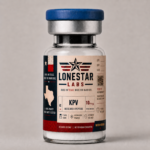
Description
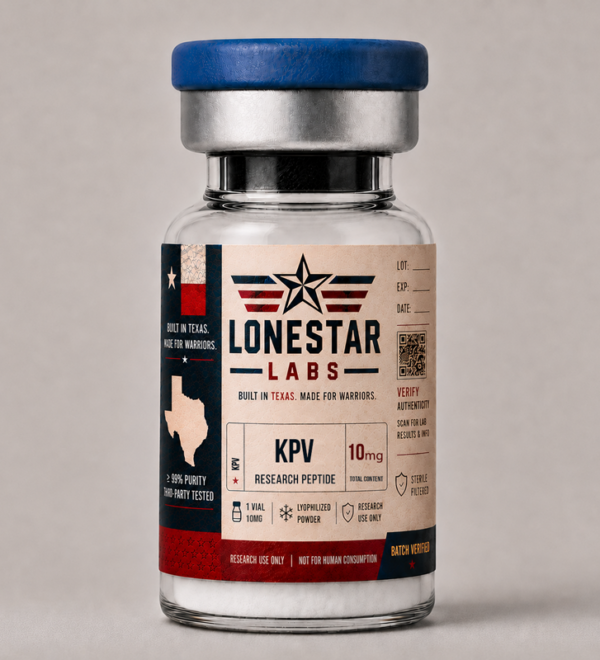
Product Classification: Research-Use-Only (RUO)
Total Content: 10 mg lyophilized powder per vial
Compound: KPV research peptide
Form: Sterile lyophilized peptide compound
Purity: ≥99%
Storage: Store at −20 °C, protected from light
Packaging: Glass vial in protective sleeve
Description
KPV 10 mg is a KPV research peptide designed for laboratory investigation of cellular signaling pathways, biological-response mechanisms, peptide-mediated communication systems, and cellular-regulation activity. KPV is frequently studied in preclinical research involving cellular communication, peptide-signaling pathways, biological-response systems, and receptor-mediated signaling activity. This pathway profile makes it useful for preclinical research into cellular signaling, biological communication, peptide activity, and pathway modeling.
This compound is intended strictly for in vitro and preclinical laboratory research.
Applications
Intended for preclinical laboratory research only, including:
- Cellular signaling studies
- Biological-response pathway research
- Cellular communication investigations
- Peptide-signaling analysis
- Cellular-regulation studies
- Biological pathway experiments
- Comparative peptide research
WARNING: Not for human or animal use. For research purposes only.
SCIENTIFIC REPORT
Abstract
KPV is a synthetic research peptide investigated for its role in cellular signaling, biological-response activity, peptide-mediated communication, and cellular-regulation mechanisms. This pathway profile allows researchers to model peptide-signaling systems in controlled experimental environments. KPV 10 mg is designed for laboratory use in studies examining cellular communication, biological-response pathways, peptide-signaling activity, cellular-regulation systems, and downstream cellular responses associated with pathway activation.
Mechanistic Pathway
KPV is designed around cellular signaling pathway modeling.
- Cellular Signaling Pathway
- Supports research into cellular communication mechanisms
- Used in biological-response and peptide-signaling pathway models
- Studied for effects on downstream signaling activity
Effect: Models cellular signaling activity in controlled research systems.
Biological Response Pathway
- Supports investigation of biological-response mechanisms
- Used in cellular-regulation and signaling pathway models
- Helps study pathway interactions within biological systems
Effect: Enables research into biological-response pathway contribution to cellular signaling.
Cellular Regulation Pathway
- Supports research into cellular-regulation mechanisms
- Used in peptide-signaling and biological pathway models
- Helps evaluate pathway activity within biological systems
Effect: Provides a model for cellular-regulation pathway research.
Pharmacokinetics / Research Profile
- Compound
- Pathway
- Research Notes
- KPV
- Cellular Signaling Pathways
- Synthetic peptide model for cellular communication and pathway research
Dosing Models in Research
Used only in controlled in vitro and preclinical research models to study cellular signaling and biological pathway response. No human or animal-use instructions are provided.
Preclinical Research Highlights
- Studied as a cellular-signaling model involving biological-response pathways
- Used in peptide-signaling and cellular-regulation pathway research
- Supports comparative studies involving cellular communication systems
- Relevant to biological signaling, cellular regulation, and pathway cross-talk studies
- Useful for evaluating downstream effects of peptide-signaling activity
Conclusion
KPV 10 mg offers a research-use-only model for studying cellular signaling pathway activation. By engaging cellular communication, biological-response mechanisms, and cellular-regulation pathway models, it supports advanced preclinical investigation into peptide-signaling systems, biological communication, and cellular pathway research.